If you have ever watched a game at a bar and wondered how to play shuffleboard yourself, you are about to learn. The game is simple to pick up, fast to play, and surprisingly strategic once you get past the first few rounds. After two decades of installing shuffleboard tables in homes across Bucks and Montgomery County, our team has explained the rules a few thousand times in the showroom — consider this the version we wish every new owner read first.
Setting Up Your Shuffleboard Table
Before you can play, you need three things: a table, a set of pucks, and shuffleboard powder (sometimes called “wax,” even though modern powder is silicone-coated beads, not actual wax).
Standard pucks come in sets of eight — four red, four blue — and each weighs about 12 ounces. Powder reduces friction along the playing surface. Different speeds play differently: “fast” powder lets pucks glide further with the same push, while “slow” powder gives you more control on shorter tables. Most owners keep two or three speeds on hand.
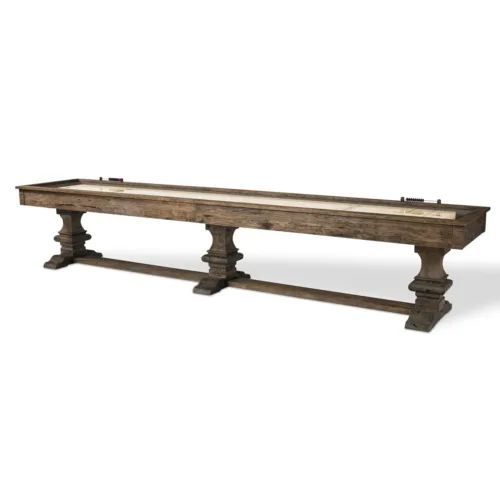
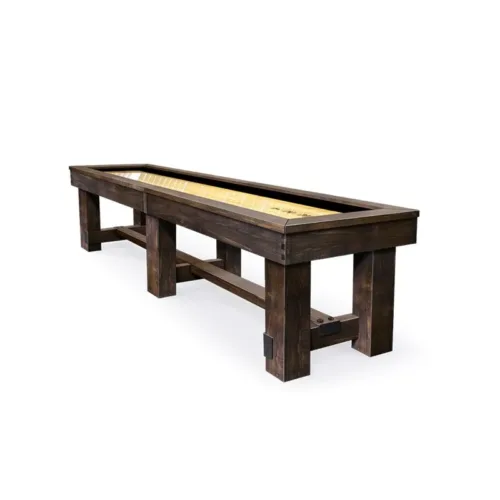
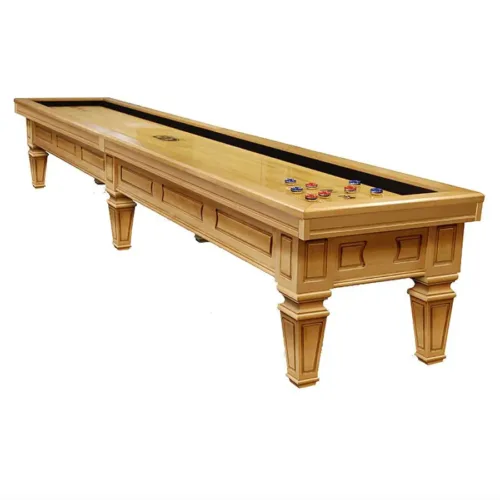
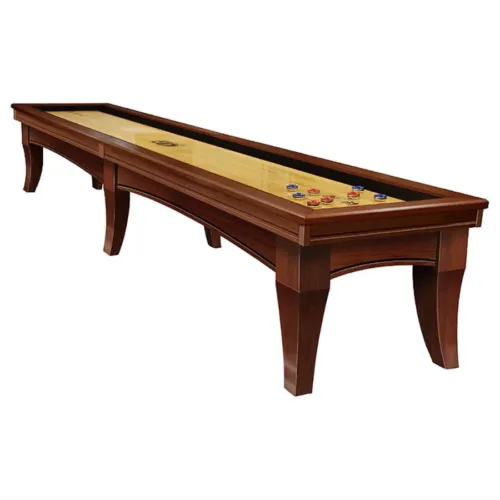
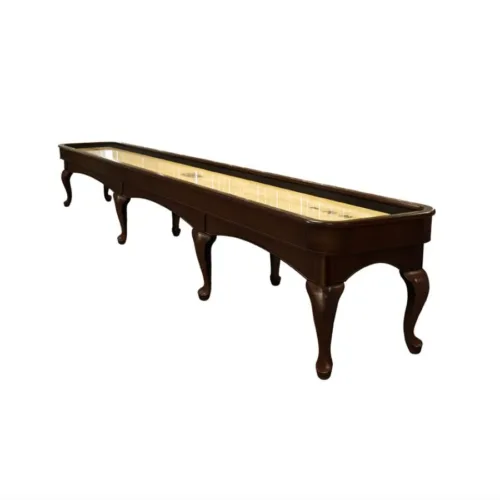
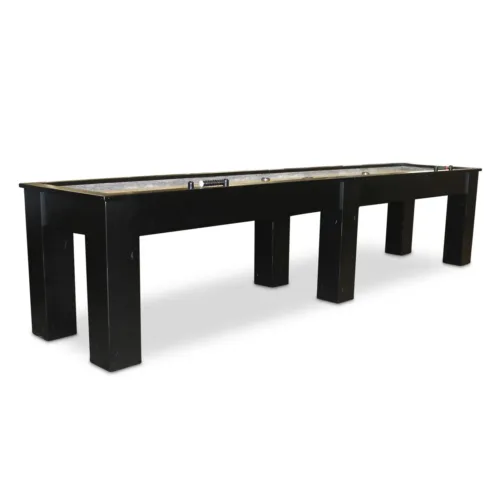
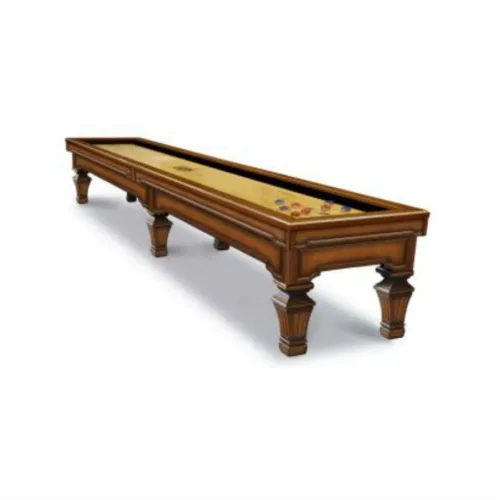
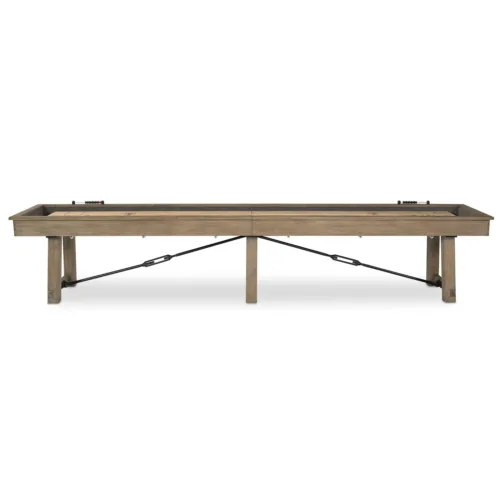
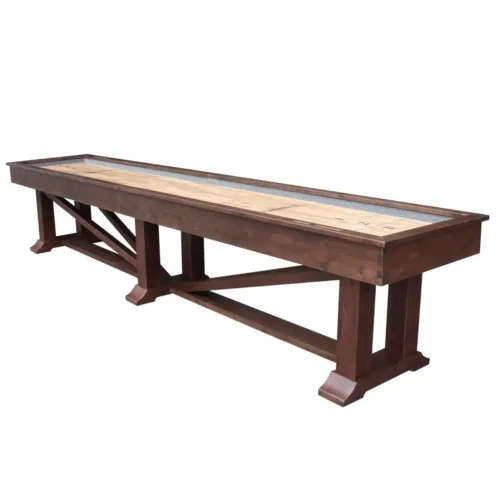
A regulation shuffleboard table has a long, narrow hardwood playfield, scoring zones at each end (1, 2, 3, and 4 points), and a foul line behind which players must release their pucks. Home tables run from 9 feet up to a tournament-grade 22 feet — the longer the table, the more skill it rewards.
How to Play Shuffleboard: The Basic Rules
Here are the basic shuffleboard rules every new player needs to know. If you are learning how to play shuffleboard at home, these are the universal rules — they apply regardless of table length or which game variation you choose.
The game is played between two players or two teams of two. Each side gets four pucks — one team red, the other blue. Players take turns sliding pucks down the table from one end toward the scoring zones at the opposite end. Once all eight pucks have been played, that round (called a “frame”) is scored. Then players reload at the other end and play back the other direction.
A puck must cross the closest scoring line to count. Pucks that fall off the end of the table or slide into the gutter alongside it are out of play. Knocking opponents’ pucks off the table is not just legal — it is core strategy. A puck that hangs over the very end of the table without falling off scores 4 points and is called a “hanger.”
Games are usually played to 15 or 21 points, and only the leading team scores at the end of each frame.
Scoring in Standard Shuffleboard
Scoring is where new players slow down, so it is worth understanding clearly.
At the end of every frame, only one team scores: whichever team has a puck closest to the far end of the table. That team then scores points for every one of their own pucks that sits closer to the end than the opponent’s nearest puck.
If your team has three pucks past the opponent’s closest puck — one in the 2-zone, one in the 3-zone, and a hanger — you score 2 + 3 + 4 = 9 points. The opponent scores zero, even if their other pucks sit in scoring zones. One well-placed shot from your opponent can wipe out a whole frame’s worth of your scoring — which is what makes the game so tactical.
Popular Game Variations
Once you know how to play shuffleboard the standard way, the variations open up a lot of new strategy:
- Knock Off (Standard). The version described above. Most common in homes and pubs.
- Tap and Draw. Each puck must lightly touch the foul line on the way out. Forces precision over power.
- Crazy Eight. Played to exactly 8 points — going over forces the score back to zero. A great fast-paced game for parties.
- Horse Collar. Frames are played one puck at a time, alternating between players. Slower and more tactical, and the variation league players tend to prefer.
Strategy for Beginners
Three quick lessons that move you past just knowing how to play shuffleboard and into actually winning rounds:
- Weight matters more than aim. New players obsess over lining up shots and underestimate how hard or soft to push. Spend your first dozen games just learning the right amount of force for your table.
- The second-to-last shot is the most important shot of the frame. Whoever places it well usually wins. Players who waste their first three pucks and try to “save it” with the last one usually lose.
- Defense is offense. You do not always have to outscore your opponent — sometimes the right play is to knock their lead puck into the gutter and let your existing puck win the frame by default.
Common Mistakes and House Etiquette
A few habits to avoid at the table:
- Do not over-powder. A light, even sprinkle is enough. Too much powder turns the surface into a luge run and frustrates everyone.
- Do not lean on the rails or sit on the table. Shuffleboards are precision instruments — leaning shifts climate adjusters over time and can warp the playfield.
- Wait until your opponent has fully released their puck before stepping up to play. Walking the rails mid-shot is the shuffleboard equivalent of jingling keys during a free throw.
Watch How to Play Shuffleboard in Action
If you would rather see the game played than read about it, our short walk-through video covers the basics in a few minutes — rules, example shots, and the most common scoring scenarios side by side.
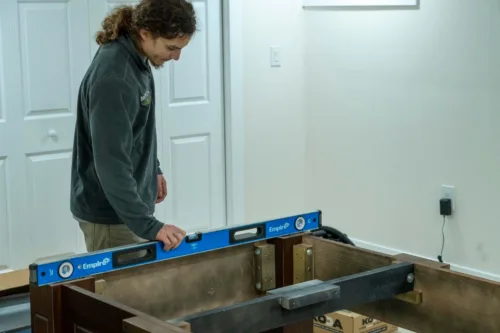
For related reading, see our guide to how to level a shuffleboard table.
Frequently Asked Questions
Are Shuffleboard Rules Different for Shorter Tables?
The basic shuffleboard rules stay the same regardless of length, but shorter tables (9 to 12 feet) play much faster and reward control over power. Tournament tables run 22 feet for a reason — the longer surface separates skilled players from lucky ones.
Do You Have to Use Powder to Play Shuffleboard?
Yes. The hardwood surface plus silicone-coated beads is what makes pucks glide. Without powder, pucks barely move. Most owners keep at least one speed on hand, and serious players collect three or four.
Is Shuffleboard Easy for Kids and First-Timers?
Very. The basic shuffleboard rules can be taught in two minutes, and even a six-year-old can land a puck in the scoring zone with a little practice. Shorter home tables (9 to 12 feet) are ideal for younger players and tighter rooms.
How Long Does a Typical Game Take?
A standard 15-point game runs 15 to 25 minutes between two players. Crazy Eight can finish in five. Horse Collar runs the longest — closer to 30 or 40 minutes.
How Royal Billiard Helps You Get Set Up
Knowing how to play shuffleboard is one thing. Owning a table that plays the way it should is another. Every shuffleboard table we sell at Royal Billiard is delivered, assembled, and leveled by our in-house team — including a full climate-adjuster setup so the playfield stays true season after season. We carry 9-foot through 22-foot tables in cabinet styles from traditional pub to modern contemporary, and we service everything we sell across Bucks and Montgomery County.
Stop by the showroom or reach out if you want to try a few before you buy. We will pour the powder and teach you the rules ourselves.
Explore our Shuffleboards

Breckenridge Shuffleboard
Call for PriceBrentwood Shuffleboard
Call for PriceChicago Shuffleboard
Call for PriceEclipse Shuffleboard
Call for PriceHampton Shuffleboard
Call for Price