The space you need for a game room depends on what’s going inside, and most people underestimate it. A pool table alone needs more than the footprint of the table itself — a cue swings out several feet on every side, and that’s before you’ve thought about a shuffleboard, a dartboard, or just having room to walk around while someone else is shooting.
Figuring out how much space you need for a game room before you buy anything saves you from a table that never gets used at full length, or worse, one that doesn’t fit at all. We measure rooms with customers at the showroom every week, so here’s how we actually walk through it and how to design a game room that works with the space you’ve got, not the space you wish you had.
How Much Space Do You Need for a Game Room With a Pool Table
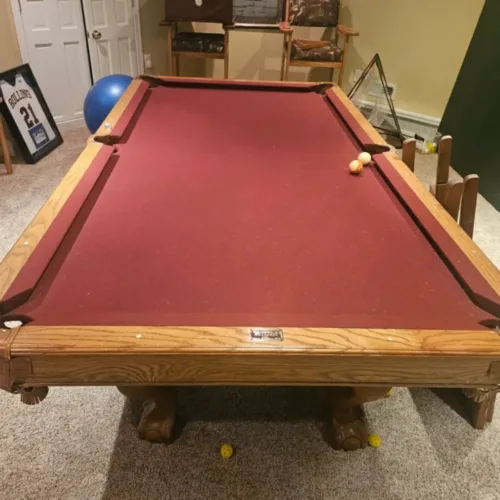
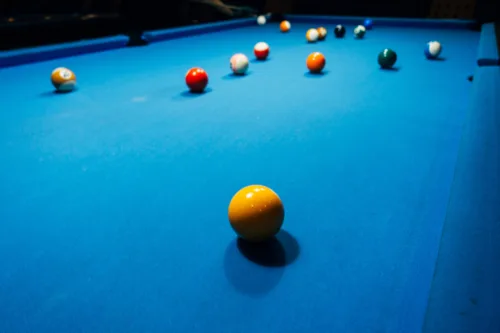
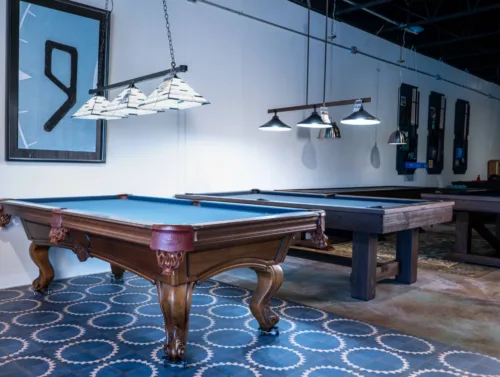
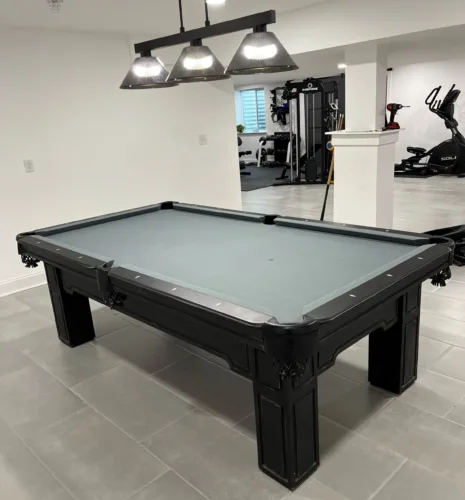
A pool table’s real footprint is the table plus cue swing on all four sides, not just the rails. For a standard 8-foot table, plan on roughly 13 x 17 feet of total room so every shot — including the tight ones along the rail — has clearance for a full-length cue. Step down to a 7-foot table and that shrinks to about 11.5 x 15 feet, which is often the difference between “it barely fits” and “it fits comfortably.”
If your room measures smaller than that, you’ve got two real options: go with a shorter table size, or use a shorter cue for shots along the rail. Either works — what doesn’t work is cramming a full 8-foot table into a room where every third shot has you bridging off the wall. The Billiard Congress of America, the governing body for pool and billiards in North America, recommends similar clearance standards for regulation play.
How Much Room Does a Shuffleboard Table Need
Shuffleboard tables run anywhere from 9 to 22 feet long depending on the model, and length is the main decision point — length is what determines how challenging (and how fun) the game plays. On top of the table’s own length, you’ll want 3 to 4 feet of clearance behind each end for players to stand, plane the puck, and follow through without hitting a wall.
A 12-foot table, one of the more common sizes for home use, realistically needs 18 to 20 feet of total room length once that shooting clearance is factored in.
Can You Fit a Pool Table and a Shuffleboard in the Same Room
This is the question we hear most from customers designing a genuine game room rather than just squeezing in one table. The honest answer: you can, but it takes real square footage — think a large finished basement, a converted garage, or a dedicated addition, not an average-sized den.
The trick is making sure the two games’ clearance zones don’t overlap during play. A pool table’s cue swing and a shuffleboard’s shooting lane both need open air, so the best layouts run the shuffleboard along one wall lengthwise and position the pool table so its cue swing zone faces open floor rather than the shuffleboard’s end. If the math doesn’t work for both at full size, picking one game as the anchor and treating the other as a smaller-footprint addition (a shorter shuffleboard, a smaller pool table) usually solves it.
Small Game Room Ideas When Space Is Limited
Not every home has 20-plus feet to dedicate to a single room, and that doesn’t mean you’re stuck with a bare wall. A few small game room ideas that make real use of a tighter footprint:
- A compact 7-foot pool table instead of standard 8-foot sizing — it plays the same game with a noticeably smaller footprint.
- A shorter shuffleboard, in the 9- to 14-foot range, which still delivers real gameplay without needing a 20-foot room.
- A wall-mounted dartboard with a cabinet — it takes up almost no floor space and works in nearly any room with 8 feet of throwing distance.
- A folding or space-saving game table for cards or poker night, which tucks away when it’s not in use.
Small doesn’t mean limited — it just means being deliberate about which games earn their spot in the room.
Other Games to Round Out Your Game Room
Once the anchor game (pool table, shuffleboard, or both) is placed, the rest of a well-designed game room is about layering in options that don’t compete for the same floor space. A few of our most popular additions:
- Arcade cabinets — most stand against a wall and need only enough clearance for someone to stand and play, no swing radius required. Our Multicade Tabletop with 60 classic games is a compact way to add retro arcade gaming without dedicating a full cabinet’s footprint.
- Dartboards and cabinets — a dartboard needs just 8 feet of throwing distance and almost no side clearance. The Dartshark American Dartboard is a solid regulation option, or go with a cloth-backed dart cabinet for a finished look that protects the wall around it.
- Ping pong tables — many fold flat or in half when not in use, which makes them a smart pick for a room that also hosts other games. The Cornilleau 500 Indoor is a durable option built for daily use.
- Card or poker tables — round things out for game nights that don’t revolve around cues or pucks at all. Reversible-top options like the Darafeev Trestle Poker & Dining Table do double duty as a dining table when the cards aren’t out, which is a smart move in a room where every square foot counts.
How you design a game room really comes down to layering: one or two anchor games that need real clearance, plus a few lower-footprint additions around the edges that don’t fight for the same space.
Frequently Asked Questions
How much space do you need for a game room with multiple games?
It depends on the games, but a room in the 20 x 20 foot range comfortably fits a pool table plus one or two lower-footprint additions like a dartboard or arcade cabinet. Fitting two larger games — like a pool table and a full-length shuffleboard — typically needs closer to 20 x 25 feet or more.
How do I design a small game room?
Start with one anchor game sized to fit your actual room dimensions (a 7-foot pool table or a shorter shuffleboard, for example), then add lower-footprint pieces like a wall-mounted dartboard or a folding game table around it rather than trying to fit everything at full size.
What’s the minimum ceiling height for a pool table?
You’ll want at least 9 feet of ceiling height to allow a full-length cue to come to a vertical position for tighter shots without hitting the ceiling.
Do I need extra space for a shuffleboard table besides its length?
Yes — plan on 3 to 4 feet of clearance behind each end of the table so players have room to stand, plane the puck, and follow through comfortably.
Not Sure What Fits Your Space? Let’s Measure It Together
Every room is a little different, and the numbers above are a starting point, not a substitute for actually measuring your space. That’s exactly what our in-house team does with customers at the showroom — we’ve been helping Delaware Valley homeowners figure out what actually fits their room, not just what fits on paper, since 1982.
Stop by our 7,000 sq ft showroom at 515 Bethlehem Pike, Colmar, PA 18915 to walk through pool tables, shuffleboards, arcade games, and more in person, or reach out to our team, and we’ll help you figure out sizing before you buy.